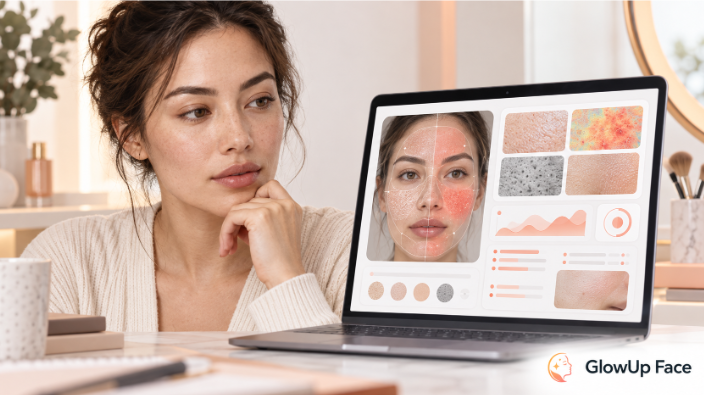
A skin-analysis app can produce a heatmap, a score and a detailed-looking plan from one photograph. Before paying for the report, ask a less dramatic question: what decision will this information help you make? A colorful result is useful only when you can understand what it describes and what remains unknown.
AI skin analysis can organize visible patterns in a picture. It should not be treated as proof of a medical condition, a product allergy or the cause of a mark. Evaluate the sample output, the quality of the input and the limits of the service before interpreting a number as knowledge about your skin.
Start with the kind of claim being made
There is a difference between describing a photograph and explaining the person in it. “More shine appears in this zone” concerns the image. “This product damaged your skin barrier” introduces a causal claim. A service needs evidence beyond a colorful overlay to support the second statement.
Look for language that explains the result rather than implying certainty. Does a redness map mean the software detected a color difference, or is the service presenting it as a diagnosis? Does an under-eye score describe brightness relative to another part of the photo, or claim to reveal sleep quality? Ask what was actually measured.
The same distinction applies to progress. A lower score on a different day does not, by itself, show that a cosmetic worked. Lighting, camera settings and the state of the skin surface may have changed too. A report should help you inspect its reasoning, not replace those questions with a percentage.
Open a sample before uploading your face
A sample lets you evaluate the format without starting with a judgment about yourself. Look for the input photograph, readable labels, explanations of each output and a clear account of what the paid version adds. Check whether the result would leave you with a useful next question or simply more things to worry about.
GlowUpFace’s sample skin-analysis report presents example signal maps and describes the optional paid report, including hairstyle previews, a routine and a downloadable PDF. Use it to inspect the format before purchasing. These are the service’s own examples and product descriptions, not independent evidence of clinical accuracy.
Read every output in that spirit. A detailed diagram can be helpful without being a medical instrument. The sample should make the service easier to evaluate, not persuade you that the number of labels, decimal places or colored zones is a substitute for validation.
Check whether the picture supports the comparison
The American Academy of Dermatology’s skin-photography guidance recommends clear focus, appropriate lighting and images that accurately show visible color and texture. That guidance is intended for communicating with a dermatologist. It supports taking a useful picture; it does not validate a consumer app’s interpretation.
Before comparing reports, check whether the photographs were taken under similar conditions. Record the camera, distance, light and whether makeup or freshly applied products were visible. Do not compare a bright, freshly moisturized selfie with a darker bare-skin photograph and assume the difference belongs entirely to your skin.
An occasional repeatability check can be informative: take two ordinary pictures under the same setup and see whether the results appear consistent. However, consistency is not the same as accuracy. Software can repeat the same mistake, and a home comparison is not a clinical validation study.
Ask what a score is relative to
A score out of one hundred needs a definition. Is it a share of an image area, a transformed measurement, a comparison with a reference group or simply an internal scale? Can the provider explain which direction means what, and whether differences between repeated scans are meaningful?
Do not assume that a five-point change represents a five-percent improvement. That calculation is valid only when the scale supports it. If the service does not publish uncertainty or explain repeatability, treat small changes cautiously rather than turning them into daily targets. It is reasonable to use an output as a prompt while declining to treat it as a precise measurement.
Keep generated images in a separate category. A smoother-looking projection illustrates an aesthetic idea; it is not a later photograph or a documented treatment outcome. It cannot tell you what a cosmetic, haircut or medical treatment will achieve for you.
Read the privacy terms as part of the product
Before uploading, find out whether the photo stays on your device or goes to a server. Check whether another provider receives it, whether copies can remain in operational systems and how deletion works. A statement that there is no public gallery answers a different question from whether private copies are stored.
Read the policy for the specific feature you will use. A website can offer an on-device tool and a separate service that uploads photographs. Do not assume the same rules apply to both. Use only photographs you have permission to share, and decide whether the stated handling is acceptable before proceeding.
Know when a report is the wrong next step
A new or changing skin spot is not a reason to keep trying cosmetic scans until one produces reassurance. The AAD’s guidance on checking your skin advises consulting a dermatologist about changes, itching or bleeding. Persistent discomfort and other concerning symptoms also need appropriate professional attention rather than a beauty score.
For an ordinary cosmetic question, judge the service by usefulness: can you understand the observation, recognize its limits and choose a sensible next step? Sometimes that step is keeping a more consistent photo record. Sometimes it is asking a professional a better question. Buying the full report is optional, and a useful sample should help you decide either way.
 Nicoleeny Castrolos, the founder of Body Care And Matter, is a passionate advocate for health and wellness. With a deep commitment to improving the lives of individuals, Nicoleeny has built a platform dedicated to delivering the latest insights on men’s and women’s health, nutrition, and mental wellness.